
XinTu Machinery Co., Ltd. – Packaging Machine Industry Blog
Technical Articles & Knowledge

Packaging Machine Blog & Insights

Expert guides, maintenance advice & machinery innovations from XinTu Machinery Co., Ltd.
XinTu Machinery Co., Ltd. – Doypack & VFFS Packaging Guides
Industry Expertise

Automated Packaging Line Solutions

Learn how to optimize production efficiency with advanced VFFS and Doypack systems

0%

A Multilane Stick Sachet Packing Machine is designed to form, fill, and seal several narrow sachets during one continuous production cycle. It commonly handles powders, granules, liquids, and other free-flowing products. Multiple lanes increase output while keeping each sachet compact and easy to store. The machine usually combines film unwinding, vertical forming, volumetric or auger dosing, heat sealing, cutting, and date coding.

The details matter. Film tension affects alignment. Filling accuracy depends on product flow and dosing design. Seal temperature must match the packaging material. A small adjustment can prevent leaking, weak seals, or uneven sachet lengths. Operators also monitor hopper levels, forming collars, sensors, and sealing jaws throughout the shift. Clean contact surfaces help protect product quality and support reliable operation.

Real production lines are not perfectly tidy. Product dust can collect. Film may wander. Some powders behave differently after humidity changes. That is why equipment evaluation should include factory trials, maintenance access, safety guarding, and documented performance data. A useful test measures speed, weight variation, seal strength, waste, and changeover time. Marketing claims alone are not enough. This guide explains how a Multilane Stick Sachet Packing Machine works, where it fits, and which technical questions deserve careful attention before purchase. It also considers operator experience, sanitation routines, and long-term service support. The right machine is not simply the fastest option. It should deliver consistent sachets under realistic production conditions. Even then, performance requires review.
What Is a Multilane Stick Sachet Packing Machine?

Machine Definition and Core Specifications: 4–20 Lanes, 30–120 Cuts/Min

What Is a Multilane Stick Sachet Packing Machine?

A multilane stick sachet packing machine produces narrow, sealed sachets in parallel. It forms film tubes, fills measured portions, seals the edges, and separates finished sticks. The lane count usually ranges from 4 to 20. More lanes can increase output, but they also require tighter film alignment and filling control.

Speed is commonly specified at 30–120 cuts per minute. A cut separates sachet sections after sealing, but this figure needs careful interpretation. In some machines, one cutting cycle creates several sachets across the lanes. Therefore, the real hourly output depends on lane quantity, sachet length, product flow, and machine stability. A 20-lane setup can deliver high capacity, yet poor powder flow may cause inconsistent weights or frequent stops.

Practical evaluation should include trial runs with the actual packaging material and product. Operators should check seal width, fill weight, film tracking, and cut accuracy at different speeds. Small changes in humidity can affect fine powders. Viscous liquids may need a different pump and sealing temperature. The 120-cut figure may look impressive. It is not always the best production setting. A slower 80-cut run with stable seals can reduce waste and rework. Specifications are useful, but hands-on testing reveals the machine’s real behavior.

How Film Unwinds, Forms, Fills, Seals, and Cuts Stick Sachets

What Is a Multilane Stick Sachet Packing Machine?

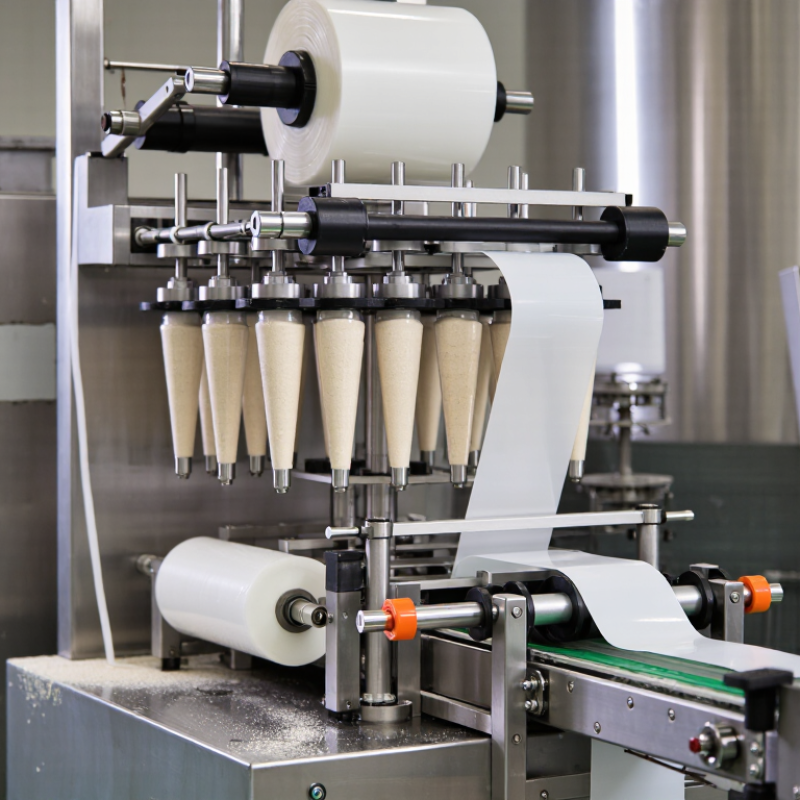
A multilane stick sachet packing machine turns one film web into several narrow packs. Its work starts at the unwind station. Rollers control tension and guide printed film toward each lane. Too much tension stretches graphics. Too little creates wrinkles. A forming collar folds the film around each filling tube. Lane alignment must remain stable.

Each dosing unit meters powder, granules, or liquid into the formed film. Sensors read registration marks and adjust film movement when needed. Vertical heaters close the back seam. Horizontal jaws create the top and bottom seals. A servo-driven knife then separates individual sachets. Seal temperature, pressure, and dwell time require close monitoring. A small deviation matters.

The Flexible Packaging Association reported approximately 40.3 billion dollars in U.S. flexible packaging sales during 2023. Smithers projects the global flexible packaging market could reach about 358 billion dollars by 2028. These figures explain the interest in compact, high-output formats, but forecasts are not guarantees. In real production, film curl, powder dust, and uneven filling can reduce efficiency. Operators still need practical checks, including seal-strength tests, weight verification, and careful cleaning around dosing parts. The machine is fast, not flawless.

What Is a Multilane Stick Sachet Packing Machine? — How Film Unwinds, Forms, Fills, Seals, and Cuts Stick Sachets
Machine Stage Data Dimension Typical Value or Range Operating Description
Machine Configuration Number of lanes 4–20 lanes Multiple parallel lanes produce several stick sachets during each forming, filling, sealing, and cutting cycle.
Machine Configuration Typical finished sachet width 10–40 mm The width depends on the product dose, film width, lane arrangement, and required package format.
Machine Configuration Typical sachet length 50–180 mm The cutting pitch or servo-controlled draw length determines the final stick sachet length.
Film Unwinding Film roll width 150–800 mm The required roll width is calculated from the number of lanes, sachet width, sealing margins, and web allowance.
Film Unwinding Common film thickness 40–100 micrometres Laminated films are commonly selected for sealability, stiffness, puncture resistance, moisture protection, and product compatibility.
Film Unwinding Web control method Tension control with edge or registration sensing The unwinding system maintains stable web tension and corrects film tracking before the web reaches the forming section.
Film Unwinding Typical film roll diameter 300–600 mm The permitted roll diameter depends on the machine frame, unwind shaft, film weight, and available installation space.
Film Forming Forming method Longitudinal folding around a forming tube A flat film web is shaped into a narrow tube around the product path, creating the structure for a center or back seal.
Film Forming Longitudinal seal width 3–8 mm The longitudinal seal joins the folded film edges and helps maintain package integrity along the length of each stick sachet.
Film Forming Film registration accuracy Typically within ±1–2 mm Registration performance depends on print contrast, film quality, web tension, sensor response, and machine calibration.
Product Filling Suitable product types Powders, granules, liquids, and pastes The filling system is selected according to flowability, viscosity, particle size, bulk density, and required dosing accuracy.
Product Filling Typical dose range 0.5–50 g or 0.5–50 ml Actual dosing capacity varies by product characteristics, sachet size, lane count, and the selected auger, volumetric, pump, or weigh-based filler.
Product Filling Filling accuracy Approximately ±1–3% Accuracy is influenced by product consistency, calibration, refill stability, dosing technology, and operating speed.
Product Filling Dust and spill control Product-specific extraction or anti-drip control Powder fillers may use dust extraction, while liquid and paste fillers may use shut-off nozzles or suck-back systems to keep the seal area clean.
Heat Sealing Sealing temperature 100–190°C The correct setting depends on the sealant layer, laminate structure, film speed, sealing pressure, and dwell time.
Heat Sealing Seal type Longitudinal seal plus transverse end seals The longitudinal seal closes the tube, while the transverse seals create the top and bottom boundaries of each individual stick sachet.
Heat Sealing Typical seal width 5–12 mm Wider seals generally provide a larger sealing area, but they also increase material use and may affect the usable package length.
Heat Sealing Seal integrity checks Visual inspection, leak testing, and seal-strength testing Testing verifies that the seal remains closed during handling, transport, storage, and consumer opening.
Cutting Cutting arrangement Multi-lane rotary or guillotine cutting The cutting unit separates the continuously sealed web into individual sachets or connected strips, depending on the package design.
Cutting Cutting pitch accuracy Typically within ±1–2 mm Servo synchronization and print-mark tracking help align the cut with artwork, tear notches, and the intended sachet length.
Production Output Typical machine speed 30–120 cycles per minute The actual speed depends on lane count, sachet dimensions, product behavior, film properties, sealing requirements, and inspection needs.
Production Output Typical sachet output 120–2,400 sachets per minute Output is calculated by multiplying the number of lanes by the operating cycles per minute, before rejecting defective packs or accounting for downtime.
Production Output Changeover time 30–120 minutes Changeover time includes cleaning, forming-part replacement, dosing adjustment, film threading, sealing setup, and test production.
Quality and Safety Common control functions No-film, no-fill, low-film, overload, and temperature alarms Sensors and interlocks help stop the machine or reject packs when film movement, filling, sealing, or cutting conditions fall outside set limits.
Quality and Safety Typical electrical supply Single- or three-phase, 200–480 V, 50/60 Hz The required supply depends on the machine design, installed heaters, motors, dosing equipment, and local electrical standards.
Quality and Safety Compressed-air requirement 0.5–0.7 MPa; approximately 100–500 L/min Pneumatic cylinders, actuators, sealing mechanisms, and product valves may require clean, dry, regulated compressed air.
Finished Sachet Common package features Tear notch, easy-open edge, printed registration, and optional perforation These features improve consumer handling and can be integrated into the film converting or packing process when compatible with the material structure.
Note: The values shown are representative operating ranges for multilane stick sachet systems. Final specifications should be confirmed through product trials, film testing, dose validation, and seal-strength verification.

Core Components: Servo Motors, PLCs, Augers, and Volumetric Cup Fillers

What Is a Multilane Stick Sachet Packing Machine?

A multilane stick sachet packing machine forms, fills, seals, and cuts several narrow sachets at once. Its performance depends on coordinated core components. Servo motors control film movement with precise acceleration and stopping. This reduces registration errors around printed marks. A PLC acts as the machine’s control center. It synchronizes filling, sealing temperature, cutting, alarms, and speed settings. Operators can monitor each lane from one interface.

Augers suit powders such as spices, drink mixes, and fine nutritional ingredients. Their rotating screws deliver measured portions through controlled volume and speed.

Volumetric cup fillers work better with many free-flowing granules. Each cup holds a defined volume before discharge. Density still matters. A change in humidity can alter weight, even when the cup setting remains unchanged.

That detail is easy to overlook. Servo timing may need adjustment when product flow changes.

Tips: Test the actual product before selecting a filler. Check powder dust, granule shape, and flow behavior. Use small trial runs to compare weight variation across lanes. Keep sealing jaws clean and inspect film tension every shift. A perfect setting rarely lasts all day. Temperature, vibration, and material buildup can slowly affect accuracy. Record adjustments, even the unsuccessful ones; they often reveal useful patterns later.

Performance Metrics: ±1–2% Fill Accuracy and 95–99% Seal Integrity

What Is a Multilane Stick Sachet Packing Machine?

A multilane stick sachet packing machine forms, fills, seals, and cuts several narrow sachets in parallel. Its value depends on repeatable control, not speed alone. Typical specifications target ±1–2% fill accuracy for powders, granules, and liquids. This range matters when each sachet contains only a few grams. A small deviation quickly becomes a costly giveaway.

Seal integrity deserves equal attention. Well-adjusted equipment may achieve 95–99% acceptable seals under controlled conditions. PMMI’s 2024 State of the Industry report values the U.S. packaging machinery market at roughly 10 billion dollars annually, reflecting continued investment in automated packaging systems. Smithers’ market research also identifies flexible packaging as a major growth area through 2028. These figures support demand, but they do not guarantee production quality.

Operators should verify accuracy through regular weight checks across every lane. Seal performance requires testing after changes in film, temperature, pressure, or speed. ASTM F88 seal-strength testing and ASTM F1929 dye-penetrant testing provide practical reference methods. However, laboratory results can look better than factory results. Dust, wrinkles, uneven tension, and product trapped near the seal can reduce integrity. The uncomfortable truth is simple: a machine may meet ±1% during a trial, yet drift beyond that level after hours of continuous operation. Maintenance records and lane-by-lane sampling reveal the real performance.

Multilane Stick Sachet Packing Machine: Performance Metrics

The chart presents the stated operating ranges for multilane stick sachet packing machines. A fill deviation of ±1–2% corresponds approximately to 98–99% fill accuracy, while seal integrity is shown across the 95–99% range. These figures are general performance metrics and are not associated with any specific company or brand.

Applications, Packaging Materials, and Selection Criteria by Product Type

What Is a Multilane Stick Sachet Packing Machine?

A multilane stick sachet packing machine forms, fills, seals, and cuts several narrow sachets simultaneously. Its value depends on the product, not only output speed. Smithers’ 2024 flexible-packaging outlook identifies continued demand for lightweight, portion-controlled formats. This supports sachets for instant beverages, nutrition powders, condiments, cosmetics, and household liquids. Powder products need auger or volumetric dosing, while granules usually require cup or weigh-based systems. Liquids need pumps, drip control, and stable sealing jaws.

Packaging material selection affects shelf life and machine performance. PET/PE structures suit many dry products and provide clear print quality. Foil laminates offer stronger oxygen, light, and moisture protection. Recyclable mono-material films may simplify recovery, but they can require tighter temperature control. According to the Flexible Packaging Association’s 2023 industry report, flexible packaging remains widely used because it reduces material and transport weight. However, lighter packaging is not automatically better. Weak seals can create costly leaks. Viscous products may also smear the seal area, reducing actual production efficiency.

Tips: Test the real product before choosing the machine. Check viscosity changes, powder dust, film slip, seal strength, and lane balance. PMMI research consistently links automation investment with labor and efficiency concerns, but line speed should not replace quality checks. Leave room for imperfect trials. A small error matters. Record reject rates, changeover time, and cleaning effort across several shifts. The best machine is often slower than expected, yet more reliable.

FAQS

What does a multilane stick sachet packing machine do?

It forms film tubes, fills measured portions, seals edges, and cuts narrow sachets in parallel.

How many lanes can the machine have?

Common configurations range from 4 to 20 lanes. More lanes can increase output, but alignment becomes more demanding.

What does the cutting speed mean?

Speed commonly ranges from 30 to 120 cuts per minute. One cutting cycle may create several sachets across multiple lanes.

Does a higher cutting speed always improve production?

No. An 80-cut run with stable seals may reduce waste compared with an unstable 120-cut run.

How should real production capacity be evaluated?

Test the actual product and packaging film. Check hourly output, fill weight, seal quality, film tracking, and cut accuracy.

Which filler suits powder products?

An auger filler suits powders such as spices, drink mixes, and fine ingredients. Its screw controls volume and delivery speed.

When are volumetric cup fillers more suitable?

They suit free-flowing granules. However, product density and humidity can still change the final weight.

What do servo motors and the control system manage?

Servo motors guide film movement and help reduce registration errors. The control system synchronizes filling, sealing, cutting, alarms, and speed.

What daily checks help maintain accuracy?

Keep sealing jaws clean. Inspect film tension each shift. Record successful and unsuccessful adjustments.

Why can settings change during a production run?

Temperature, vibration, humidity, dust, and material buildup can affect accuracy. A perfect setting rarely lasts all day.

Conclusion

A Multilane Stick Sachet Packing Machine is an automated system designed to produce multiple narrow sachets simultaneously, typically operating with 4–20 lanes at speeds of approximately 30–120 cuts per minute. The machine unwinds packaging film, forms it into individual tubular channels, dispenses the product, creates longitudinal and cross seals, and cuts the finished sachets into separate units. This continuous process supports efficient, consistent packaging for a wide range of products.

Key components may include servo motors for accurate movement, PLC controls for coordinated operation, auger fillers for powders, and volumetric cup fillers for granules or other free-flowing materials. Typical performance targets include fill accuracy of about ±1–2% and seal integrity of 95–99%, depending on the product and film structure. Selection should consider product characteristics, required lane count, filling method, packaging material, sachet dimensions, production speed, and sealing requirements. Common compatible materials include laminated films and other heat-sealable structures suited to the product and storage conditions.

Jackson

Jackson

Jackson is a dedicated marketing professional with an exceptional deep knowledge of our company’s products and services. He plays a pivotal role in our marketing team, consistently driving engagement through insightful and informative blog posts on our company website. With a keen eye for detail......